Eventide Temperance Lite Free: Modal Reverb Plugin Offer
Eventide's free Temperance Lite plugin offers tunable modal reverb with chromatic control, <1ms latency, and 3 room models. Limited-time offer ending soon.
Modal Reverb You Can Actually Tune: What Makes Temperance Lite Different
Physics-Based Resonances Replace Algorithmic Smear
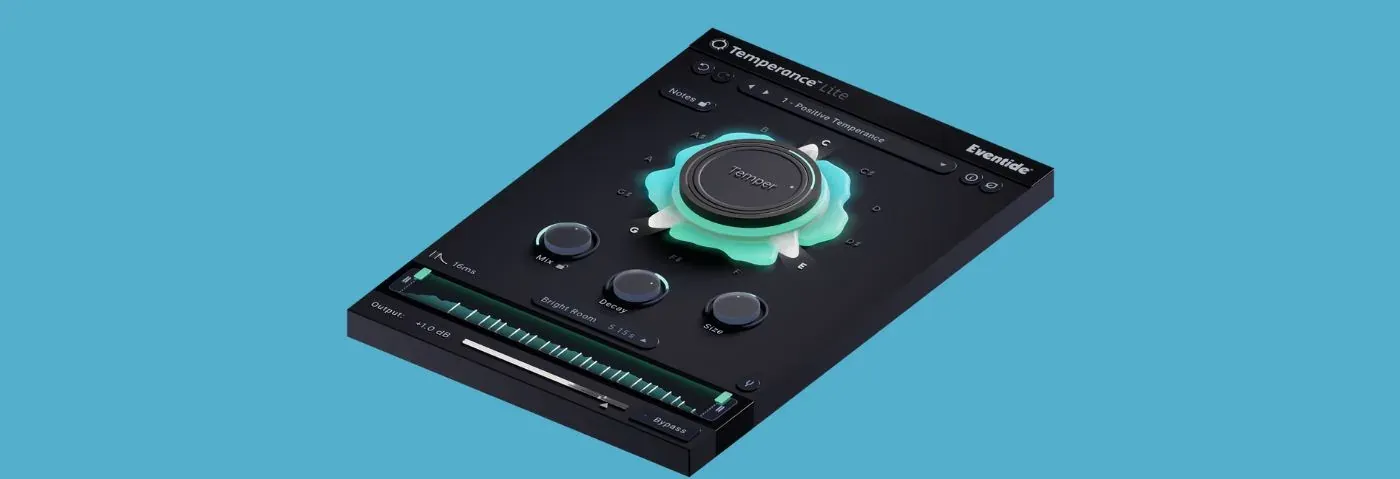
Eventide's Temperance Lite models acoustic spaces as thousands of independent resonators—each with adjustable frequency, decay, amplitude, and phase—rather than relying on traditional algorithmic feedback networks or convolution snapshots. This modal approach treats reverb tails as tunable harmonic structures, enabling producers to emphasize notes within a 12-tone chromatic scale or suppress dissonant frequencies via the central Temper knob.
Three reverb spaces ship in the free version: a Bright Room derived from Eventide's SP2016, a Large Studio modeled after Dr. Ralph Kessler's acoustically optimized environment, and a Synthetic Space for experimental soundscapes. Latency remains under 1 ms, making the plugin viable for tracking sessions and live performance setups where real-time monitoring demands zero perceivable delay.
Three Rooms, Chromatic Control, and a Deadline Worth Watching
Chromatic Note Selection Meets Real-Time Visualization
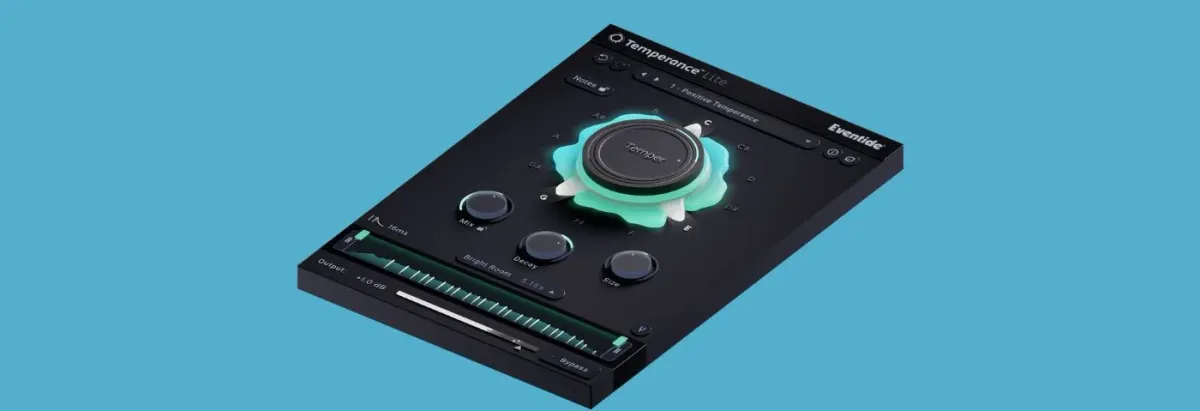
A radial selector grid lets producers emphasize or suppress any of the twelve chromatic pitches, steering modal energy toward harmonic consonance or controlled dissonance. Clockwise rotation on the central control amplifies chosen frequencies; counterclockwise movement attenuates them, offering bidirectional tonal sculpting unavailable in conventional plate or chamber emulations.
NoteScape Visualizer displays sustaining resonances alongside a built-in spectrum analyzer, providing immediate visual feedback as notes bloom and decay. Standard Mix, Decay, Pre-delay, Size, and Output Level controls retain workflow familiarity, while Range Sliders isolate frequency bands and High/Low Pass filters refine harmonic focus. Reference Frequency knobs with cent-level fine-tuning accommodate alternate temperaments, extending modal control beyond equal-tempered 440 Hz tuning.
Why Pitch-Aware Reverb Matters for Electronic Music Production
Harmonic Resonance as a Tonal Layer
Electronic producers frequently battle reverb muddiness when sustained pads, bass, or melodic lines clash with decay tails in the 200–500 Hz range. Modal control addresses this by selectively boosting notes that align with the track's key signature while attenuating dissonant partials, preserving clarity in dense arrangements. The NoteScape Visualizer displays which frequencies sustain or fade, offering real-time feedback that traditional convolution tools cannot match.
For ambient and downtempo workflows, emphasizing specific scale degrees—fifths, minor sevenths, or suspended fourths—transforms tail behavior into a harmonic extension of the source material. This pitch-aware approach integrates reverb as a melodic voice rather than a spatial effect, particularly valuable when layering arpeggiated synths or tuned percussion without sacrificing tonal coherence.